
Voice of Session House 2021: Ami Chong (鄭亜美)
Ami Chong (鄭亜美), who works as a theater actor in productions including those of Oriza Hirata, is a third-generation Korean resident of Japan and has faced discrimination many times since childhood.
But she has pushed back against it and continued to seek paths across the boundaries found throughout society. In 2021, she took part in a Mademoiselle Cinema performance as a dancer.
Ami Chong (鄭亜美): “A Body Crossing Borders”
When I was asked to write this piece, I was given the theme “A Body Crossing Borders.” I thought that a body crossing borders is exactly what Naoko Ito calls “traveling dance.”
“I think dance is a journey.” During rehearsals for “Tokyo—Under the Sky,” Naoko Ito said this many times.
Now that the performances are over, I have become able to think about the meaning of these words anew, with a lived sense of what they mean.
In these pandemic times, when we hesitate to travel freely either within our own country or abroad, human beings can nevertheless use the power of imagination to cross one boundary after another. The heart and the body are always free. I think Naoko Ito wanted to convey that to everyone.
“Crossing borders” means stepping between countries, or across boundaries. Traveling. When we encounter situations with different languages and cultures, we cannot help changing, to a greater or lesser extent, from who we were before. So perhaps “a body crossing borders” can be rephrased as “a body undergoing transformation.” Perhaps “a body undergoing transformation” can be rephrased as the course of the process itself. And I thought that this is precisely where the meaning of a work lies. Not what we make, but how we make it. For example, Naoko Ito talks about a truly wide range of things during lessons. Sometimes she even stops the dancing to talk. “What do you wish for?” On the first day of lessons for “Tokyo—Under the Sky,” Naoko Ito asked every performer this question. It takes a great deal of courage to confess your wishes among people you have only just met. But probably everyone felt that her question was essential, directly connected to the body. Tamami Takenoshita began, and each of us went on to talk about our various “wishes.” I, too, was extremely hesitant to say what was in my heart, but looking at the faces of the members, I decided to speak honestly. I answered, “I want to live an ordinary life.”
I was born and raised in Japan as a Korean resident of Japan. My roots go back to the annexation of Korea by Japan in 1910, but because my parents let me attend Korean school, I was able to learn Korean—the language of the Korean Peninsula where my roots lie—and its culture. Yet the moment I stepped outside school, I was subjected to shouted abuse, and having people spit on my school uniform, the chima jeogori, on the way to school was a frequent occurrence. Because I do not use a so-called Japanese name—an alias—since high school I have been turned down for part-time jobs over the phone. Often someone who had been responding pleasantly before I introduced myself would become unpleasant the moment I gave my name. Now, a quarter-century later, I had hoped the world would be better, but it has not become so. Government-generated hate speech runs rampant, and life has become increasingly difficult. Open the internet and there is a storm of abuse; false rumors about nonexistent “special privileges for Koreans in Japan” circulate widely, and a movement to falsify history, making events that happened appear never to have happened, has become a dominant current. I answered Naoko’s question honestly: from the bottom of my heart, I want to live ordinarily, without being attacked the moment I give my name, in a life where I can exercise my rightful rights on the basis of a sound understanding of history. I was extremely worried about how this would be received—sadly, without a shared recognition of historical facts, it is rarely received favorably. But Naoko spoke to me from her experience of protesting against the right-wing people who had attacked at the time of the “Unfreedom of Expression Exhibition (表現の不自由展),” scheduled to be held at the Session House gallery in June 2021. I felt truly reassured. At the same time, I was concerned: what if the other members had taken it as “I’m suffering so much, so understand me”?
But that concern faded as I danced with everyone. From the day after the question, under the Tokyo sky of 2021, we began a process of finding common ground through dance, and it became an exceptionally precious experience. Onstage, we formed formations and faced our great common enemy. Naoko will not allow us simply to dance. Even forming a scrum or dancing in pairs cannot work without trust in the other person. We are inevitably pressed toward a transformation
of our relationships. In one scene called “Back Alley,” each of us expressed the form of our own prayer through the body, taking “prayer” as the theme. I think one of the characteristics of human beings is to “pray,” and we spent a great deal of time creating “Prayer in the Back Alley
.” Far removed from rationality—prayer is irrational to begin with—what is a praying body? What makes dancing, or not dancing, necessary? We shared a great deal of time. And I feel that only those hazy feelings reaching toward realms that cannot be put into words brought us onto the stage.
Normally, I belong to a theater company and act in plays. Most theater uses the tool called “dialogue.” Dance, however, uses the tool called the “body.” Personally, this too made an impact worthy of “crossing borders.” But in the work we do in order to stand onstage with others before an audience, there was not a single difference between theater and dance. I felt anew that words—dialogue—and the body are inseparable. And I found renewed hope in the fact that we already possess bodies capable of crossing borders at any time.
Ami Chong (鄭亜美)
Excerpt from Voice of Session House 2021
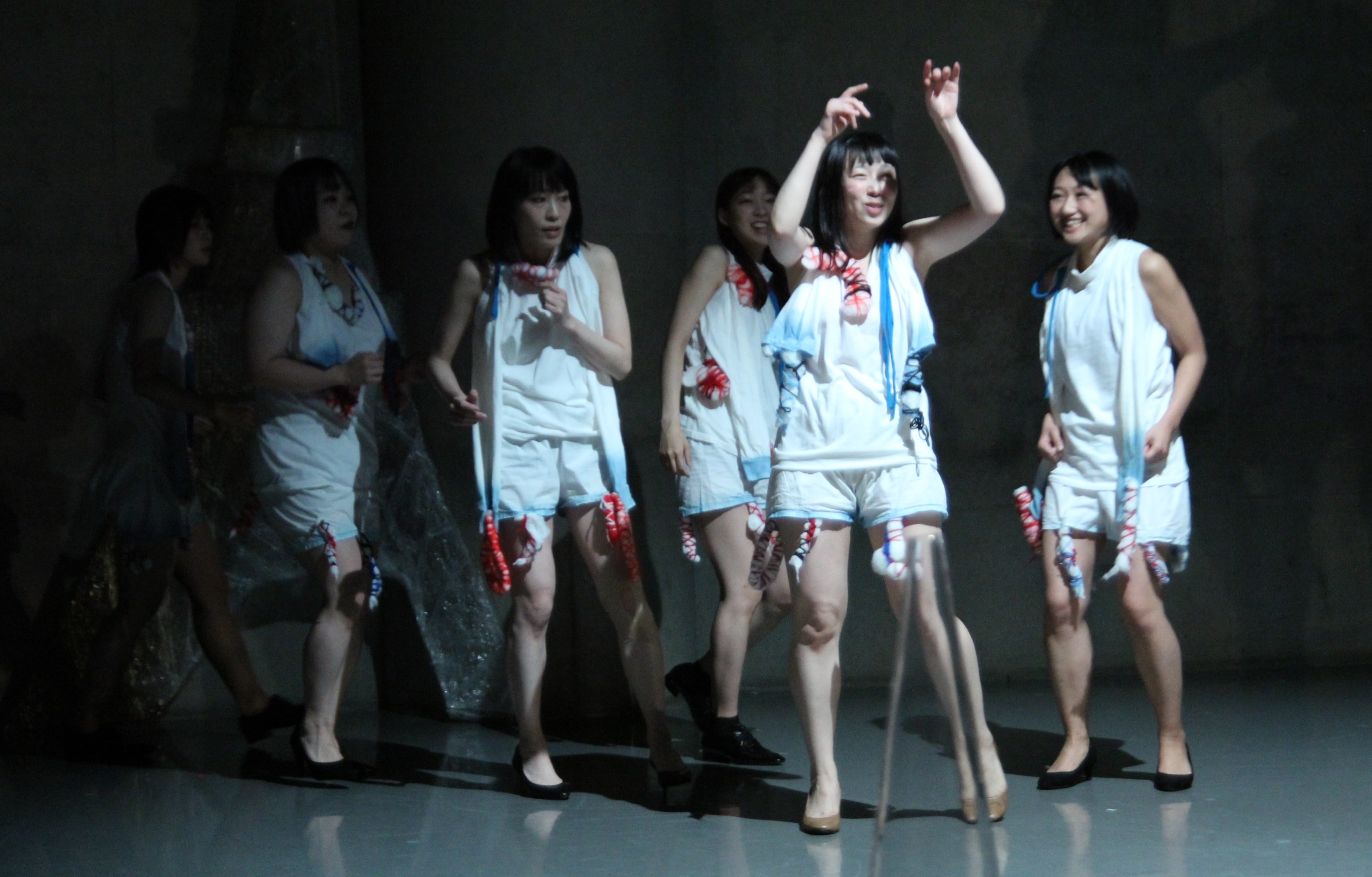
Dance Bridge: “TOKYO—Under the Sky”
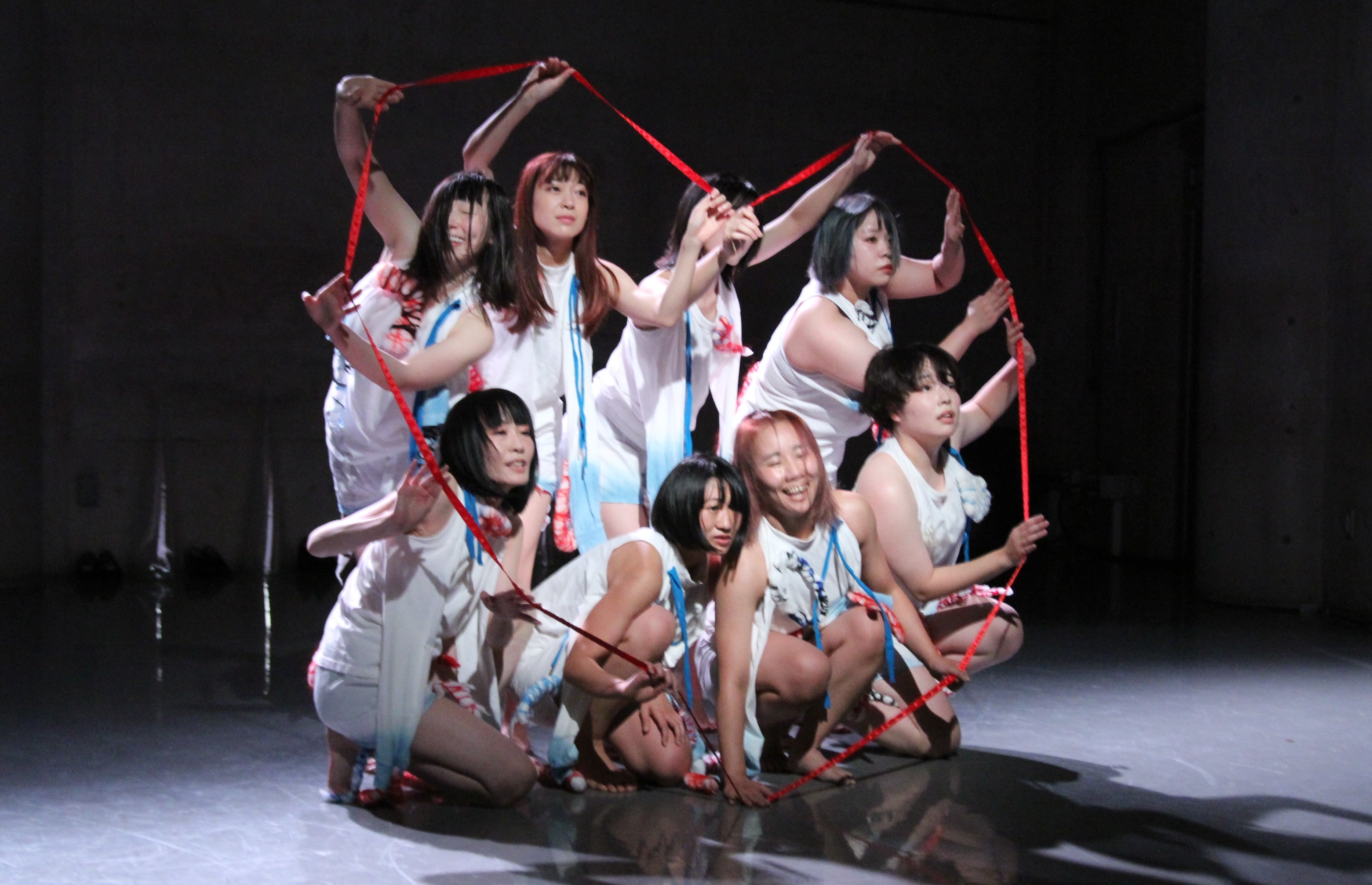
Dance Bridge: “TOKYO—Under the Sky”
