
Voice of Session House 2021: Naoko Ito
Naoko Ito, who leads Mademoiselle Cinema and directs Session House’s dance program, speaks about the feelings with which she has presented performances during the pandemic, and the thoughts that have emerged through her activities.
Naoko Ito: “The Third Year of the Pandemic”
The pandemic—a disaster in which everyone became a victim equally! A reality we had never imagined struck the entire world. We have threaded our way through it and continued the activity of dance, even as it was called nonessential and nonurgent. At Session House, fewer seats brought unexpected advantages: it was easier to see, and “You can even see the floor!” Stages on which dancers face audiences directly have continued to encourage them. Accepting the intentions of people who choose to watch a performance in these circumstances has also been deeply connected to each dancer’s awareness of the question “Why dance?” Moving beyond the relationship of “seeing and being seen,” a stage where people first ask themselves “Why watch?” and “Why dance?” and then dance and encounter one another is, I believe, an important opportunity for those who express themselves.
The other day, we were fortunate to have Min Tanaka, with whom I had shared a stage nearly fifty years ago, dance at Session House. This was a memorial performance for an improvisational guitarist named John Russell, a project bringing together Akira Sakata, Ken Ikeda, and the dancer Min Tanaka for a session. The organizer, Ohki (大木), is also an old acquaintance. Watching the performance as memories from nearly half a century ago flashed back, I felt that it swept away even the absurdity of the pandemic and approached the essence of humanity. Min dances his dances as “ba-odori,” dance of the place, and spends his days farming; the saxophonist Sakata also has a side as a researcher of water fleas; and Ikeda fills the space with sound like wind, like trees, like clouds. In their session, the music and the dancing body were of the same nature, with no bargaining between human beings whatsoever. To call it communion between souls would be commonplace. The work of these three, transforming a single second into eternity, must be the fruition of each one’s sincerity toward their own expression, sustained by a long span of time.
Akira Kasai has that same sincerity, and Ryohei Kondo possesses it too. Though each arrives at a different place, this was a trembling experience of touching the human activity called dance, called art, through which a person brings their sincerity to fruition over the long years of a lifetime.
It was through collaboration with the lighting, through the work of giving things form and dissolving form, that I felt the truth that this world and the other world are clearly separate. The lighting changed quietly, like the environment of our living days. Before I knew it, the spotlight that had continued to illuminate the deceased went out, and Min’s face approached as though in close-up. I empathized with the sorrow of those who survive.
We have now found a ray of light in online formats and continued our activities. This, too, is one method we discovered amid the pandemic. Watching on a smartphone and the joy of connecting with people far away are experiences we did not know before coronavirus. Things discovered, things lost: these two years have been a major experience for each and every one of us. New experiences must be important things to pass on to a new era. And more than that, I want to tell hearts wounded by the pandemic that now, of all times, it is necessary to experience live dance in the body. In this era it is hard for anyone to stay free of illness. For those who dance, courageously offering the darkness they carry and exploring the power to transform it into dance through which we empathize with one another is also a challenge particular to this moment. “I want you to see live performances.” “I want you to dance your own dance.”
Even with audience seating halved, what supports dancers who still intend to keep dancing is the presence of audiences who maintain their intention to watch. The audience is a home for the dancing person’s soul. That I could now feel “hope in the act of dancing” through watching Min’s dance may also have been a voice from heaven telling me to reclaim the passion of my youth fifty years ago, when I became deeply absorbed in dance. On this day of my third vaccination, thinking about hope for a time after coronavirus is also an inevitability of the times. I will walk the road of continuity, seeking companions along the way.
Naoko Ito
Excerpt from Voice of Session House 2021
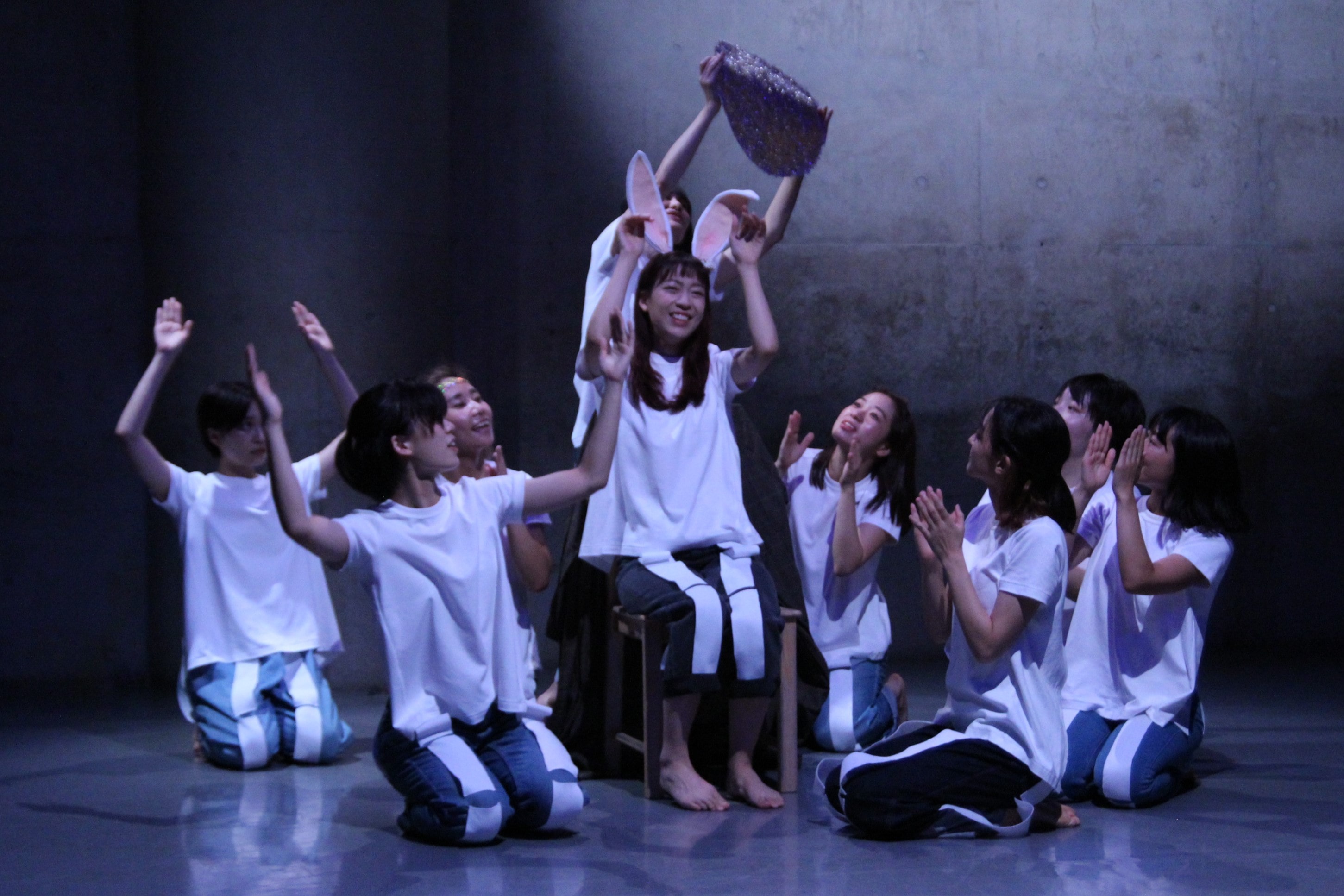
Mademoiselle Cinema: “Soragana-ku (そらがな区)” (Future Dance)

Akira Sakata (left) and Min Tanaka (right)
