
The Importance of Dancing Live
Wataru Kitao, active on many stages, appeared in Mitsutake Kasai’s Night Session and in “Dance Bridge,” themed around laughter, in 2025, showing us unique performances. We asked him to talk about the fascination and importance of dancing live.
Wataru Kitao (director of Baobab)
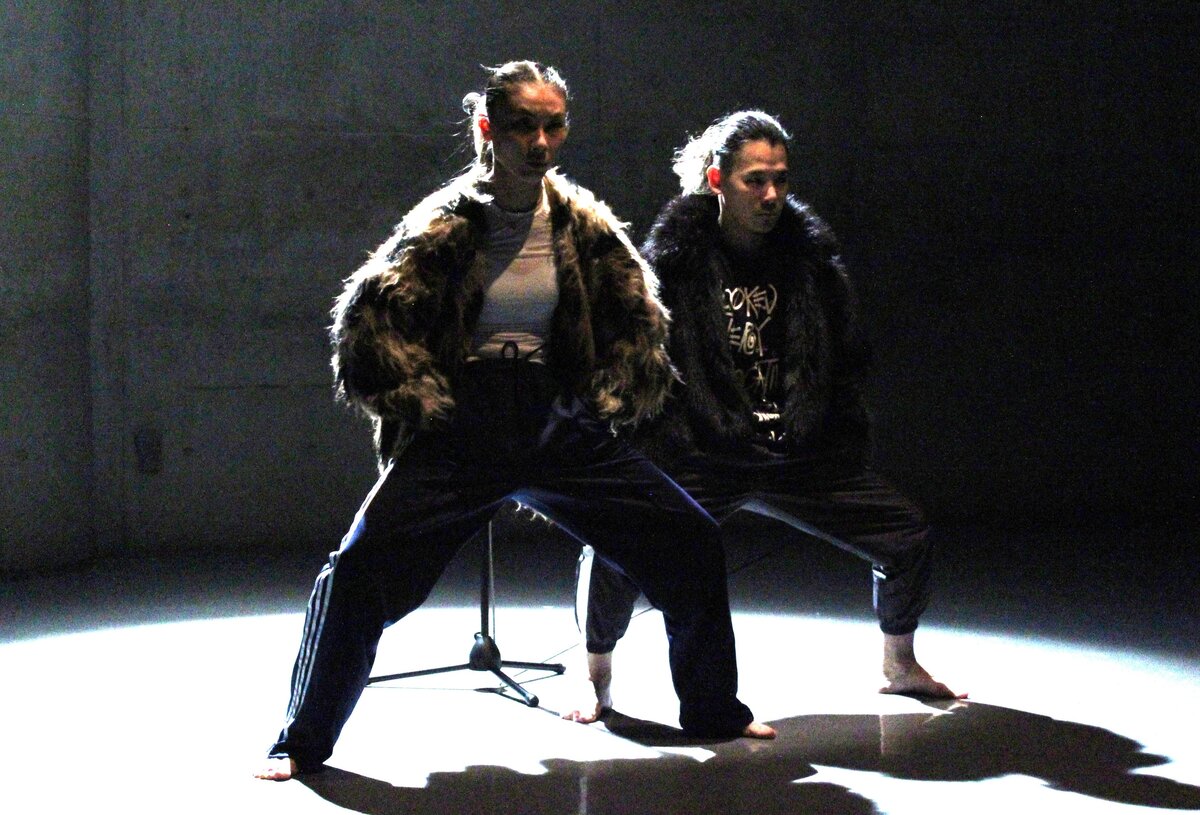
Yu Okamoto (岡本優) and Wataru Kitao
Congratulations on Session House’s 35th anniversary! I am filled with respect and gratitude that it has continued to be loved by so many people for so long as [a place that nurtures dance and keeps sending out new forms of expression]. I also feel (presumptuous as it may sound) that it is a source of hope for the contemporary dance world. Becoming such a center of expression is also a goal for “Baobab,” the company I lead. As someone about 20 years behind you, I hope to keep following your impressive example!
When I entered university at 18, having grown up in the worlds of musicals and street dance, encountering the unknown world of contemporary dance was a shock. Now, 20 years later, I feel it has gained an unbelievable degree of recognition. I see it danced in music videos, and children I meet through outreach (something like workshops brought to them) call out, “I know contemporary!” In this generously accommodating world with no definition of its genre, what makes each dancer and creator identify themselves as “contemporary”? That is something I have increasingly been wondering about lately.
As for me, my theme is always to keep seeking “new expression.” That might be the flow of movement or the way counts are taken in choreography; the moment-by-moment details of improvisational dancing; freshness and surprise in the direction and structure of a full-length work; or the choice of the work’s subject itself. I keep searching for new expression with a constant feeling of “fighting déjà vu.”
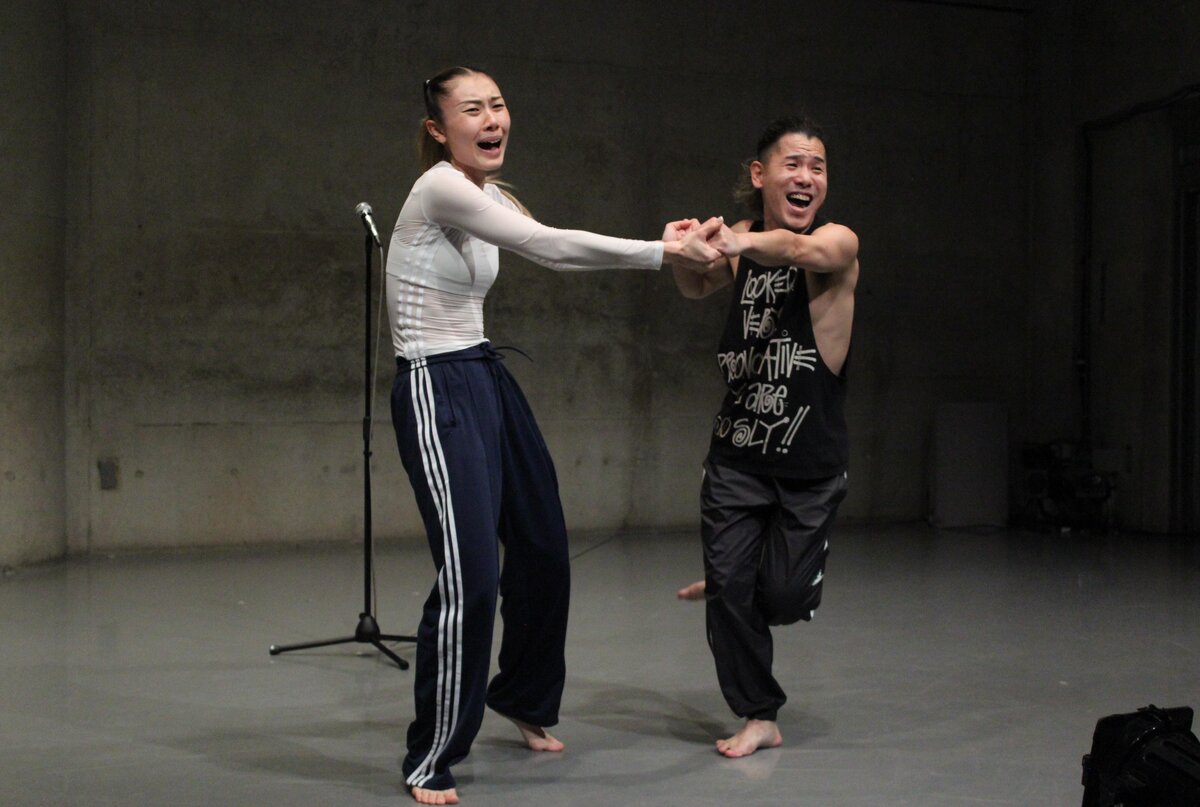
Yu Okamoto (岡本優) and Wataru Kitao
In “Mitsutake Kasai night session live ‘09’,” which I joined last year, I spent most of the time dancing all the movements of Beethoven’s Ninth in a dizzying succession of questions to myself: “New ideas! Let the next move overturn expectations!” “Is this the right spatial choice?” “Déjà vu! You’re lousy!” Continually searching for new expression can sometimes be brutally demanding. (Laughs.)
I think this disposition is influenced in part by my tendency to get bored easily and be contrary, but much of it comes from the teaching of my mentor, Kuniko Kisanuki (木佐貫邦子). When I still knew nothing about contemporary dance, she gave me a substantial seed of words: “Have doubts.” When dancing, always keep the question “Is this really right?” in a corner of your awareness. Cultivate a sense that does not settle comfortably for only what you have built through rehearsal and training. That seed has since grown into a major root—a core—of my work-making too. These precious “leaves of words” have shaped me. When I participated in Dance Bridge 2025 with “Iconic,” a duet co-created with Yu Okamoto (岡本優), this theme played an important role in the creation. Responding to the overall performance theme of “laughter,” I remained conscious of “tension and release” in the direction (following the words of the second Katsura Shijaku [二代目桂枝雀]). I feel that a joke’s “setup” and “punchline” are born through overturning expectations. How far can we overturn the audience’s ideas and our own? This is precisely the sense of direction I always value, including in Baobab. In that sense, I was given a valuable opportunity to rediscover just how compatible laughter is with my own values. “Meeting expectations while defying predictions”: I feel that my own contemporary dance also exists somewhere within that.
The present day swirls with innumerable streams of information. Society’s circumstances change at a dizzying pace. Right in the middle of it, what happens—or can we make happen—in a dance named “contemporary = of the present/of the same era”? And what can it do?
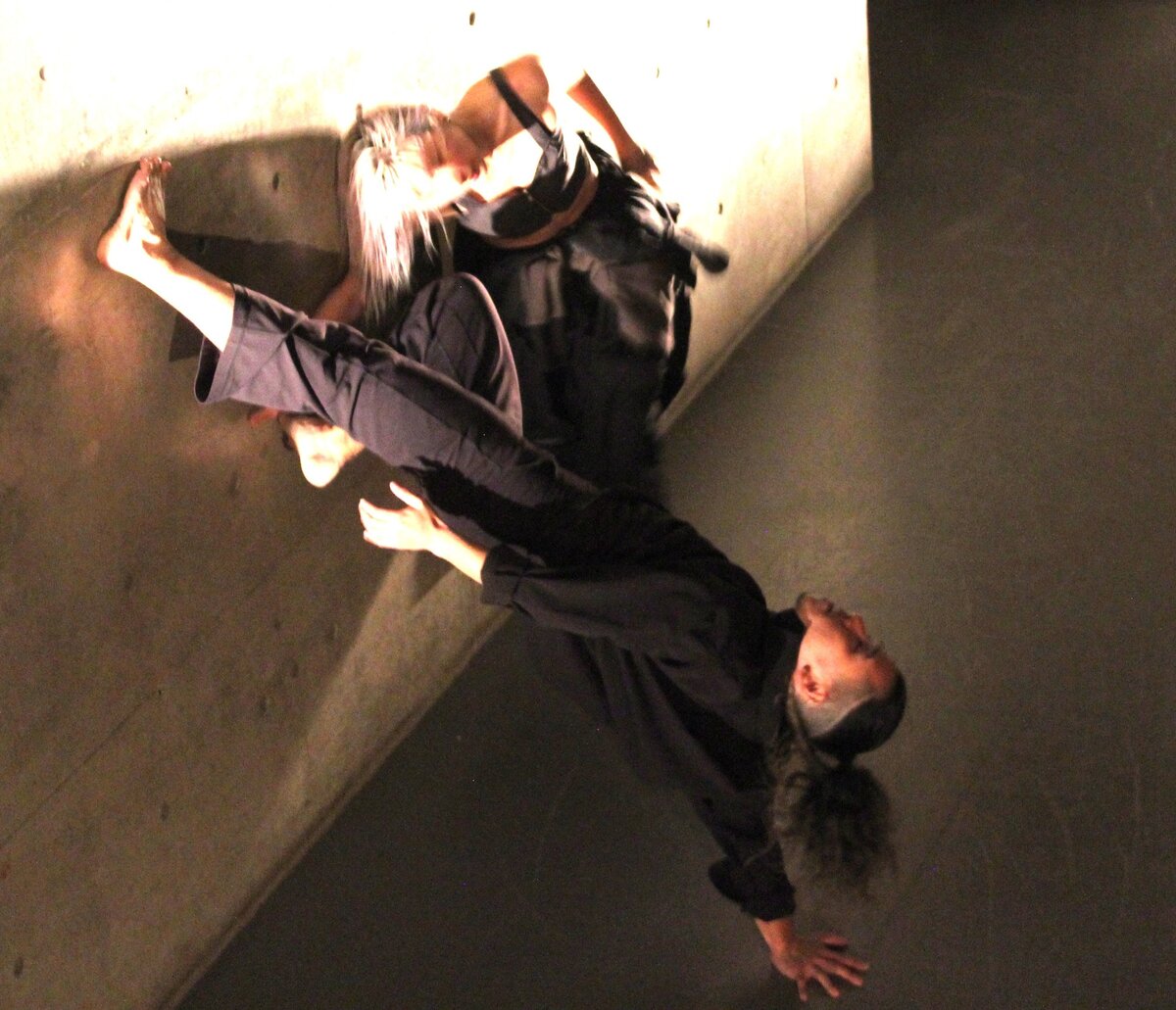
Participating in Mitsutake Kasai’s Night (Wataru Kitao)
Another sense I want to cherish is “being LIVE.” A LIVE space where flesh-and-blood dancers setting their bodies in motion and the audience witnessing them share the same time and place. I want there to be a depth that cannot be grasped on YouTube or savored on TikTok. D.LEAGUE’s overwhelming power and professionalism are wonderful, but sometimes I want, at close quarters like those of Session House, to experience a person in all their sweetness and bitterness, from skill to error. That is also my wish as a fan of watching dance. And, if possible, I also hope that “what happened in that space (= the dance, the work) will seep into the lives of the audience who witnessed it.” Long ago, on my teacher’s recommendation, I saw NODA MAP’s “The Rope” (2006) for the first time. Its impact made me abandon the path toward musicals I had been pursuing. Faced with an overwhelming masterpiece of contemporary theater that surpassed show entertainment, I could not get up from my seat. I still remember the bodily sensation of moving back and forth between the work’s world and everyday life in unexpected gaps in my days—for days, months, even more than half a year afterward. I think I turned toward contemporary dance from there because I began to feel, “Someday I want to create a spectacle that speaks to the present like this. I want to portray something essential, not only fleeting entertainment.”
Since this is “dance of the present/of the same era,” I want to make works that do not imitate other genres and are not bound “only” to existing works (novels, plays, paintings, music) or historical facts! I keep looking for dance that reaches the present, daily life and society—“contemporary dance” in the true sense. New expression surely exists in everyday life, between the waves of the currents of our era. And I hope there are audiences, like me, seeking works that make them notice it (or experience it physically). I got a little carried away.
