
Voice of Toyoaki Onogi
In 2023, classical performing arts producer Toyoaki Onogi once again approached Mademoiselle Cinema, inviting the company to the grounds of Bishamonten in Kagurazaka and, in the autumn, making possible a joint performance with women gidayu musicians at Session House. He shares the thoughts behind this project.
From Reproduction to Renewal @ Kagurazaka Traditional performing arts producer / Koten Kukan Toyoaki Onogi
On Saturday, November 11 and Sunday, November 12, 2023, “Women Gidayu × Mademoiselle Cinema: Kagurazaka Bridge, Bridging with the Neighborhood / Beyond Layers of Time—Resonating Voices, Resonating Together / From ‘Shōutsushi Asagao Banashi’ (生写朝顔話), the Akashi Boat Parting scene through the Ōi River scene” was staged three times over two days.
The members of Mademoiselle Cinema, Taiju Matsumoto performing readings and dance, and the two women gidayu artists—the tayu narrator Kyōnosuke Takemoto (竹本京之助) and shamisen player Kazu Tsuruzawa (鶴澤賀寿)—each confronted the others in a “serious contest.” It was simply a stimulating, exhilarating time. Last year, Naoko Ito consulted me about a joint performance by the two groups. Ito had happened to pass by and overhear Kyōnosuke Takemoto rehearsing joruri at the “Neighborhood Exchange Event Space Kagurazaka Commons 1st,” operated by the Shinjuku NPO Network Council, a general incorporated association. When I heard Ito's idea, the more I thought about how it could be realized, the more, honestly, I felt at a loss.
The members of Mademoiselle Cinema have been involved with us for three years in “Kagurazaka Street Stage / Oedo Tour,” which unfolds over two days each May with the whole Kagurazaka neighborhood as its stage. They took on collaborations with Tsugaru shamisen × shakuhachi × jazz piano × drums in 2021, a seventeen-string koto in 2022, and traditional Japanese hayashi music (small hand drum, large hand drum, taiko, flute, and other instruments) in May this year—all instrumental performances. This time, however, it was joruri (gidayu-bushi), shamisen music with a text… with words. Moreover, the text is in Edo-period Osaka dialect. Gidayu-bushi is an emphatically traditional performing art, premised on forms and patterns that cannot be broken down. Could contemporary dance, whose guiding principle is free, abstract bodily expression, really mesh with it? I confess that I agonized over that question.
So I consulted Takayuki Hioki (日置貴之), a researcher of Japanese theater and associate professor in Meiji University's School of Information and Communication, whom I know through Kagurazaka. He agreed to participate as supervisor and to prepare the script for the spoken readings. After discussion, we chose the joruri “Shōutsushi Asagao Banashi” (生写朝顔話), excerpting it and combining it with readings to make a work of about one hour in three parts. It was first performed as ningyo joruri, puppet theater, in Tenpo 3 (1832). Miyuki (深雪), daughter of Akizuki Yuminosuke (秋月弓之助), falls in love with Miyagi Asojiro (宮城阿曾次郎) while viewing fireflies in Uji. Later, when a marriage proposal arises, Miyuki runs away, not knowing that the proposed husband is Asojiro. Having wept her eyes blind, she becomes the blind woman entertainer Asagao (朝顔), wandering and repeatedly missing her chance to reunite with Asojiro in this tragic love story; after many twists and turns, they are finally united.
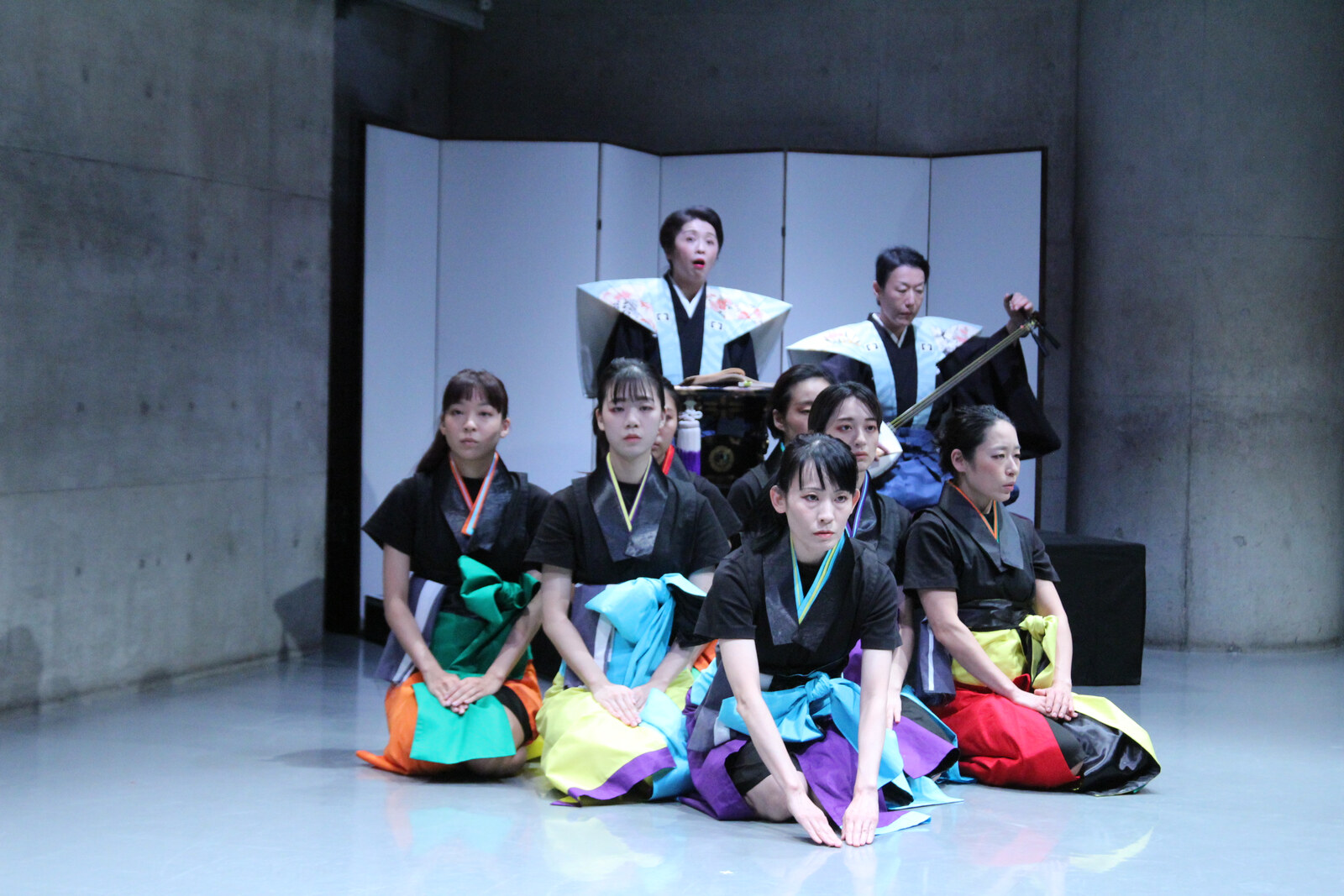
What left a deep impression during the process of shaping the work was that Naoko Ito and the members of Mademoiselle Cinema watched recordings of the puppet-theater work many times, carefully read every word of its text, and transformed it into bodily expression with their own interpretation while keeping the story's development intact. Ordinarily, a work has forms and patterns built up through repeated performances by puppets or kabuki actors. This time, however, they approached “Shōutsushi Asagao Banashi” from scratch, using the methods of contemporary dance, the methods of Mademoiselle Cinema, and created a new expression. Every work, every masterpiece, necessarily has a “first performance.” Something touches people's hearts, is refined through repeated performances, and eventually is handed down as a “classic” to the present day. Perhaps it is precisely because I am drawn to the essence born in that process that I have stayed involved with this genre for so long.
I was accustomed to seeing “Shōutsushi Asagao Banashi” on puppet-theater and kabuki stages, but in its encounter with Mademoiselle Cinema's bodily expression, each word of the joruri (gidayu-bushi) seemed to come alive again, as vividly powerful language in a way I had never felt before. I felt I had witnessed exactly the “renewal,” not “reproduction,” that we seek when engaging with classical works. The task of meshing gears with an expression alien to one's own nature… and markedly different at that. I imagine the energy devoted to it this time was extraordinary. Perhaps this was an essential experience for the traditional art of gidayu-bushi to carry on its stylized expression and continue to exist as a “living performing art” in the present, whose values differ from those of the age in which it was born. And at “Kagurazaka Street Stage / Oedo Tour 2024,” planned again for this year, a collaboration is scheduled between Mademoiselle Cinema and four up-and-coming shakuhachi players. There are no words, but the sound produced by a bamboo wind instrument that directly extends the musician's body is the closest thing to words. I have great hopes for the world created by sound and bodies confronting and responding to one another.
Toyoaki Onogi
Excerpt from Voice of Session House 2023
