
Toyoaki Onogi: Hopes for Collaboration — Voice of Toyoaki Onogi
Kagurazaka, where Session House is located, is an area that still carries the atmosphere of old Japanese culture. Toyoaki Onogi, a producer of classical performing arts, has taken a central role in promoting collaboration with Session House’s dance programmes. Here is his passionate message.
Traditional performing arts producer; representative of Koten Kukan (古典空間): Toyoaki Onogi
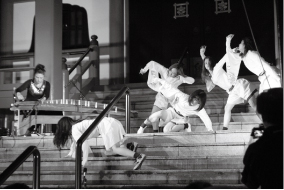
Mademoiselle Cinema in the grounds of Bishamonten
At least until 2020, Japanese society could be said to have repeatedly advanced and risen, with economic value as its centripetal force. I cannot help feeling that the COVID crisis abruptly braked that momentum while also giving us a hint. Pause our advance and ascent… leave an "interval," turn our gaze backward and downward, and pay attention to the value accumulated in the past that lies at our feet. Might not this accumulation itself be expressed by the word "tradition"?
An event called "Kagurazaka Machibutai—Oedo Meguri" (organisers: Arts Council Tokyo, Tokyo Metropolitan Foundation for History and Culture / the NPO Iki-na Machizukuri Club; support and cooperation: Tokyo Metropolitan Government) has been held since 2013. Over a Saturday and Sunday in mid-May, traditional performing arts fill the Kagurazaka area: Bishamonten Zenkokuji Temple, Akagi Shrine, Yarai Noh Theater, live music venues and long-established shops, Kagurazaka Street and its surrounding alleys, and more. Various forms of music played on traditional Japanese instruments—koto, biwa, shamisen, kokyu, shakuhachi, flute, small hand drum, large hand drum, taiko—and bugaku, noh, Japanese dance, kodan, rakugo, rokyoku, daikagura and even tezuma: artists currently active at the forefront present one live performance after another, each lasting about 20 minutes, simultaneously at multiple locations. This is also a cultural programme of the Tokyo Metropolitan Government, staging "encounters" with traditional performing arts, with which contact is becoming sparse in everyday life, against the backdrop of the town of Kagurazaka, where traditional culture breathes. What is especially noteworthy is that the event is built together with the people of Kagurazaka—the town.
It has also become a major undertaking that could not exist without the efforts of many people: concierges who learn about traditional performing arts in advance and explain them to visitors; volunteers who provide historical guidance and information about the stamp rally; and everyone who offers their facilities as venues, among others. This year marks its eleventh edition, and it could be called a familiar early-summer feature of Kagurazaka.
Before COVID, around 40,000 visitors came each time, creating a great bustle. But like everything else, it was affected by the pandemic, and in 2021 it was held indoors as an online stream without an audience.
On May 23, Session House hosted a live session by four musicians playing Tsugaru shamisen, shakuhachi, piano and drums. With no distinction between Japanese and Western instruments, these skilled players, whose creed is truly to enjoy weaving sounds together, created a pleasant space in which tension and relaxation alternated. Then, in the final piece, "Kokiriko-bushi," a collaboration with the members of Mademoiselle Cinema came into being. As music and bodily expression responded to one another, fiercely heightened inner feelings were expressed without adornment. It was a truly stimulating creation, deeply etched in my memory. I cannot help regretting that facing
the audience was not possible. Last year, as the situation improved, we were able to hold the event with an audience. On May 21, at Bishamonten Zenkokuji Temple, using the steps leading up to the main hall as a stage, we realised a collaboration with the seventeen-string bass koto. The "conversation" that unfolded on the theme of prayer felt as though sound and dance were filling one another’s gaps and creating a space of salvation, like a helping hand being extended. For some reason, I felt refreshed. Koto, contemporary dance and a temple: it was truly a collaboration in which all three became one.
Now that so many phenomena are becoming borderless, collaborations also take place frequently in the performing arts. Expressions that transcend their origins and the backgrounds they carry meet and stimulate one another, giving birth to new expressions and works; that is the very reason for art’s existence. At the same time, precisely because division and conflict are the reality of society, the role art plays ought to grow. Different genres share a theme with which they empathise, and work toward creation through repeated cooperation with that theme as the centripetal force. Through that process, some message is born and something is communicated.
Now, traditional performing arts… attaching the word "traditional" to performing arts seems to evoke a variety of images. Some people feel the weight and value of tradition, while many surely think, "Difficult, old-fashioned, hard to approach…" The younger the generation, the more likely the latter is to be the reality. We must begin by acknowledging that traditional performing arts have many "hurdles": language barriers, the pace of expression, the need for prior knowledge. On the other hand, if we interpret the former as "outstanding expressions and works born from the everyday culture of the past, which can become spiritual nourishment enabling those who receive them to live through tomorrow, even as time passes and places and languages differ," and if, moreover, they were born and nurtured in Japan’s climate and culture, then all the more reason to seek to share their value across every generation.
There is a reason things are handed down. In that process, repeated refinement produces styles and forms. It is precisely in those styles and forms, therefore, that we can perceive the meaning and essence of transmission. Nor are styles and forms only to be repeated: by applying them to approaches toward new creation, we can maintain freshness and acquire contemporaneity. In any case, I understand the test of our skill to be how we extract and present the elements that are "interesting, enjoyable and cool" without losing sight of the essence. There is no right answer, though; we can only keep experimenting and practising. "Kagurazaka Machibutai—Oedo Meguri" is a place to encounter traditional performing arts, and at the same time an ideal opportunity for their practitioners to put into practice the contemporary challenges of "transmission, dissemination and creation." Next time, I hope we can deliver a message from the "interval" through a collaboration between Japanese hayashi music and the members of Mademoiselle Cinema.
