
Tamami Takenoshita: What Will We Leave a Hundred Years from Now? — Voice of Tamami Takenoshita
Tamami Takenoshita, one of the performers who danced "Woman Is a Journey" as the third instalment of "Family Stories, Past and Present," talks about the thoughts she brought to the work.
Tamami Takenoshita
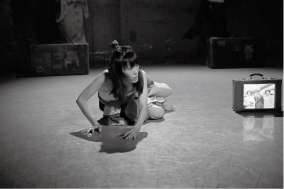
Under the project "Family Stories, Past and Present," Mademoiselle Cinema performed "Woman Is a Journey," depicting the young women who crossed the ocean as picture brides a hundred years ago.
The venues were our home base, Session House, and Tanami Theater (田並劇場) in Kushimoto, Wakayama Prefecture, with which a chance connection had brought us together a few years earlier. I was told that Kushimoto is an area from which many Japanese once departed overseas and lived as immigrants. The sea I actually saw in Kushimoto sparkled in the sunlight on clear days; the distant horizon was straight, and beyond it seemed to be a world full of hope. In reality, their lives as immigrants involved harsh labour, and they were caught up in war and forced to live in internment camps. The picture brides’ hope, courage and despair. I felt darkness and light at the same time. And dancing "Woman Is a Journey" in a place like that gave me a strange feeling—as though I had become a storyteller of history, as though I had really experienced events a hundred years ago—and a profound sense of responsibility.
"Family Stories, Past and Present" also included two other performances, Kentaro Kujirai’s "Song of Akasha" and Mitsutake Kasai’s "Poem of Joy." Both were works in which I felt the unbroken connections of family. After seeing them, I could savour the flow of time through my body, reflecting on the history that had led up to now and thinking about the future ahead.
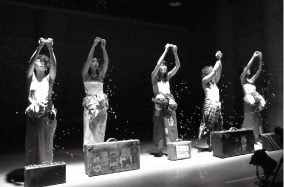
Mademoiselle Cinema, "Woman Is a Journey"
What these family stories depict is not people who accomplished great feats, but the stories of ordinary people in everyday life. History is often told from the perspective of the powerful, and the loudest voice tends to become justice. But we must not forget that behind it sleep the many histories of nameless people.
A hundred years from now, I may no longer remain in the form of myself. But if I think of it as an era involving our children’s and grandchildren’s generations, it is not such a distant future. Knowing the past, reconsidering the present, looking toward the future. This project proved that dance can offer a chance to think about those things. I am proud to have been able to take part in this meaningful project.
