
Kentaro Kujirai: The Thoughts Behind "Song of Akasha" — Voice of Kentaro Kujirai
Please listen to Kentaro Kujirai, who presented the dance work "Song of Akasha" as the second instalment of "Family Stories, Past and Present." Based on his grandfather’s account of his wartime experiences, the work combined dance with readings, chorus and Okinawan dance.
Kentaro Kujirai
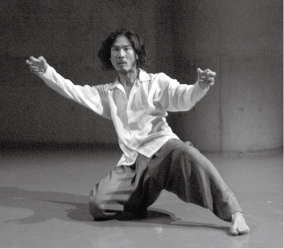
I have never created a dance work by linking it to a political assertion. Yet as long as dance makes the body itself the work, I think it cannot be unrelated to the body’s history, memories and connections with the past. Bodily art contains a polarity: the concrete, material aspect of the body and the mental aspect that defines conceptual things. We could also call these physical actions and the thinking activity of the head.
I also imagine that within this human body, with its bones and flesh and circulating blood, sleep billions of years of the earth’s memories and the history of humankind since creation.
Exhaled breath, the resonance of voices uttered, gestures cutting through space—perhaps these are imprinted in this atmosphere as transparent strata. If we listened closely to the memories of these cells, might the body begin resonating with something beyond individual memory, or with something like a collective unconscious beyond space?
With towns that no longer exist, extinct creatures, festivals and traditional performing arts, the cultural continuity that shapes a people’s identity, and even events taking place far away on the other side of the earth.
When I consider the relationship between bodily art and social events from this resonant perspective, dance cannot remain unrelated to events that people living in the same era consciously or unconsciously come to share: the COVID crisis; the Fukushima nuclear accident during the Great East Japan Earthquake; the terrorist attacks of September 2001; the series of arbitrary media reports about Aum Shinrikyo in the 1990s.
At the same time, however, my interest turns first to an artist’s view of the body, rather than to the message expressed by each work.
This is because the relationship in dance between "I / subject / choreographer" and "body / object / dancer" can be considered the most microscopic configuration of society, a place where familiar power structures manifest themselves—a site of politics. In the relationship between the subject in choreography or movement and the moving body that embodies it, what kind of "freedom" is produced? Or does a structure of authoritarian domination, like a military organisation, arise? This is surely directly connected to how creative work in collaboration with others is organised, and I feel it appears in the artist’s style of work—their view of the body. Digging deeper into each artist’s view of the body leads us into the labyrinth of asking where the subject of dance exists in the first place. But for me this question connects with the place where dance begins. As in a sprint,
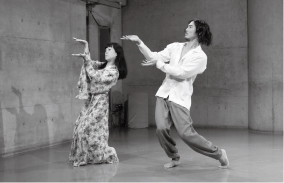
“Song of Akasha”
even if you try to move your body at the command "On your marks, get set, go!" you cannot begin dancing. For me, the very beginning of creating something, the instant when an impulse arises from the wellspring of the body and becomes dance, feels as though a wind of intuition suddenly blows in from afar, and receiving that wind brings some movement into being. Perhaps it is close to the state of a poet facing a blank sheet just before writing a poem. No external power whatsoever operates there; only the pure beginning of the dance impulse exists, as an anarchic vacuum.
I felt I could dance my grandfather’s memoir of the war in northern Okinawa because I clearly sensed there a wind of necessity transcending time and space. At the same time, it is also true that I felt this was not something I, his grandson, could carry alone. The Imperial Japanese Army’s 32nd Army, to which my grandfather was assigned through the mobilisation of students, was established to defend Okinawa, Taiwan and the Nansei Islands—south of 30 degrees 10 minutes north latitude and east of 122 degrees 30 minutes east longitude. In northern Okinawa, where my grandfather fought, boy soldiers called the Tekketsu Kinnotai carried out suicide attacks, and battles to the death were fought to buy time before the decisive battle on the mainland. But there was another concealed mission: a "secret war" plotted by Imperial General Headquarters in anticipation of a mainland battle after Okinawa fell. Surviving Japanese soldiers and civilians were to merge into guerrilla units and continue espionage and surprise attacks against the American occupation forces. In practice, however, this secret operation did not function at all; what it brought about was the division of Okinawan residents. Japanese soldiers regarded even children and women as potential American spies, and residents, consumed by suspicion, were forced into the inhumane espionage of informing on one another. Then came the tragedy of horrific massacres of residents by Japanese soldiers. The cruel "secret war," kept hidden and considered unspeakable after the war—many of us Japanese entered the 21st century without knowing about it, while the war in northern Okinawa remained sealed away in the dark recesses of history. This fact is not merely a humanistic issue concerning the inhumanity of war. For me it is a question of the bloodline flowing through this body, or of "the rationality of the Japanese body."
And the question of where continuity as a people can actually be found within this body is, for me, an extremely important perspective in dancing. When I imagine the country of Japan not as territory but as a single transparent human body, it seems to me that its head had already been severed before the Pacific War. It also brings to mind the famous tanka by Ken Kasugai (春日井建), whom the writer Yukio Mishima called a modern Teika: "Is this the stillness after the great sky’s beheading? The purple left behind by the sun that has sunk." But pursuing this further, I think it connects not only with the misery of war, but with the history of domination and subjugation stretching from the emperor, once regarded as an absolute ruler and held sacred, to Ryukyu, and even to the Ainu and Emishi. It would run through relationships such as "centre / city" and "frontier / region," monotheism and shamanism, the West and Japan.
And might it connect directly from the nature of postwar Japanese society, in which patriarchal authority ended, to the questions of governance and anarchism, power and freedom, in dance’s "I / subject / choreographer" and "body / object / dancer," and the "relationship between head and limbs"? South of 30 degrees 10 minutes north latitude, east of 122 degrees 30 minutes east longitude. These signs have become an abyss, cut off from the mainland and cruelly separating Japanese from non-Japanese, still engraved in this body and exposing their depths. Perhaps I could go on living with memories beyond my individual lifetime still asleep.
But how do we face memories once they have awakened? Hoping that I might hear in them a call from the future, I danced "Song of Akasha—A Student Soldier’s Memoir of the War in Northern Okinawa, by Iwao Kujirai (鯨井巖)."
