
Interview with Ryohei Kondo — Voice of Ryohei Kondo
We asked Ryohei Kondo, who became artistic director of Saitama Arts Theater in April 2022, to talk about the possibilities of working in a large theatre and in small theatres such as Session House.
(Interview: Takashi Ito / 伊藤孝)
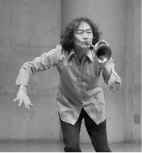
Q: Besides the Saitama theatre, you’re doing all kinds of activities in different places. Allocating your time must be difficult. Within that large system, how much of your time is committed to the theatre?
K: As for the time I’m tied up, there’s a foundation, and my duties include checking documents such as the annual programme and stamping them with my seal. That can take a week at a time. Otherwise I’m not tied up that much. But last year, my first year actually working as artistic director, I was there almost every day from April to the middle of August.
Q: I went to see your first project in Saitama, the performance based on the concept of Crossing. It was a large-scale production with people from all kinds of genres—dancers, theatre people, a live band, circus performers—just the sort of project a large theatre makes possible. Did you feel it was a new challenge for you?
K: Not really. It was still just an attempt at something like that. Inviting people is easy, but I do wonder whether the substance was good enough. What I really want to work on is how we spend the time; I think we’d need to commit people for at least a month. The question is whether we could give something like 20 performances during that time. With dance, you might have about 10 rehearsals and still give only two or three performances. So at a large theatre the issue is how long you can secure people’s time. In that sense, big places have their difficulties.
Q: Have there been requests for a certain number of projects like Crossing each year?
K: You could say there have been requests, but it’s up to me. I’m thinking about different Crossing patterns, each with a slightly different meaning.
Q: In terms of the number of works, how many does that mean?
K: Officially, two works, but last year there was "New World," which you saw, then a Condors performance, and after that a play called "Making Mistakes as Though Being Guided." There are all kinds of patterns. In the summer we also did something called "Open Theater," a sort of introduction to the theatre, showing dance in various places around it. We called it "Born on the Planet of Dance."
It was like a social-studies field trip introducing the different spaces.
Q: That’s different from having the audience take part in the dance.
K: That’s something for the future. The Saitama theatre is a prefectural hall, so I’m travelling around different parts of Saitama to think about how we can connect with the prefecture. I’d also like to develop Crossing on that basis.
Q: Meanwhile, you’re also giving performances, workshops and classes in small theatres like Session House. How do you see the place of small theatres?
K: This isn’t a big place, but when I first came here there were so many things I didn’t know, so it was a place with enormous significance for me. You could call it the starting point of my thinking. In that sense, Session House has a tremendous role. What you do here hasn’t changed much; it’s stayed steady, hasn’t it? You can think and experiment on your own, and when you want to try making a work, there are quite a few things you can do on a compact scale. The organisation at a theatre like Saitama is big, so compared with that, it’s easy to get things moving here.
Q: Is it a good thing for you to have both now?
K: Of course. This feels like a place where you can easily meet people. But so many people watch online now that we’re living in a difficult time when it comes to getting people to make the trip to a theatre.
Q: Naoko Ito, who oversees the programming, is having a hard time attracting audiences too.
K: With Miho on lighting and Ueda on sound, this place has the warmth of something hands-on and handmade. That’s something you simply can’t replace.
(Interview: Takashi Ito / 伊藤孝)
