
Session House Annual Report 2018: Mitsutake Kasai
Overall direction by Mitsutake Kasai: “Taiwan (Women and Men) × Japan (Men) × Japan (Women)”
What We Found Through Exchanges Between Works…
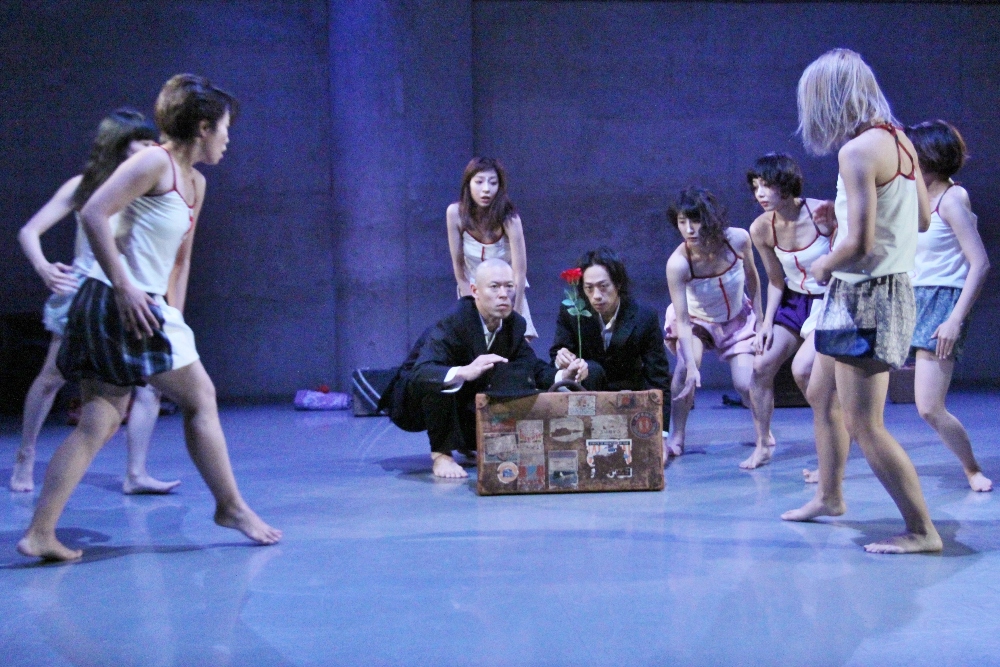
Mademoiselle Cinema performed a work called “Crossing the Sea.” We carried out an exchange in which Kasai and Okuyama joined Mademoiselle Cinema’s work, and dancers from Mademoiselle Cinema joined ours. Participating in one another’s works in this way is common, but trying to add a bridge section to two completed works and connect them into one was a first experience for me too. It is the task of adding new writing to two different, completed novels to turn them into a single novel. There, two different stories gradually become one.
First, I will write about the two of us joining Mademoiselle Cinema. We began by going to rehearsals to explore how the work was being made and what positions would allow the two of us to blend into it. We were careful that our participation should not shift the message or essence the work originally possessed. We aimed to give it greater dimensionality by adding the two of us. Mademoiselle Cinema is an all-female group. Simply having two men enter adds a different color to the work. As for our position, we thought it most desirable to exist within the work rather than focus on movement. Walking, seeing, touching, speaking, and so on.
Next, Mademoiselle Cinema joined our work.
1. The bridge connecting the two works. 2. The dance portion of one woman’s story. 3. The unison dance in the middle section. 4. The final, ending dance. Broadly speaking, we asked the Mademoiselle Cinema dancers to take on these four parts.
1. The part that glues the two works together: from the first volume to the second. The transition from one novel to the next. The image of turning a large page.
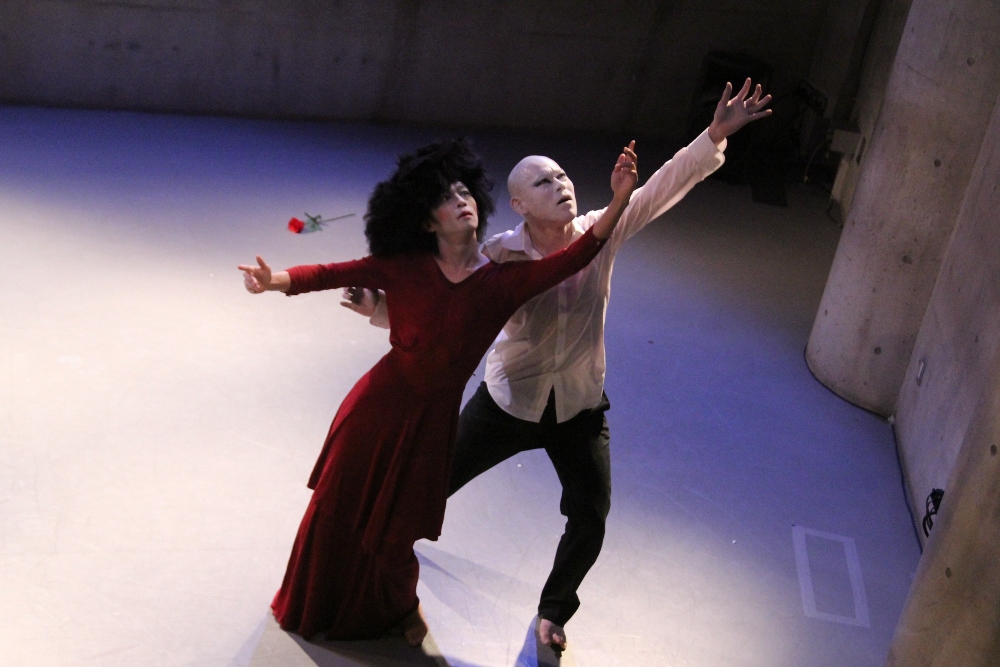
2. Based on a manuscript Okuyama had written, a dance in which one man falls in love with one woman.
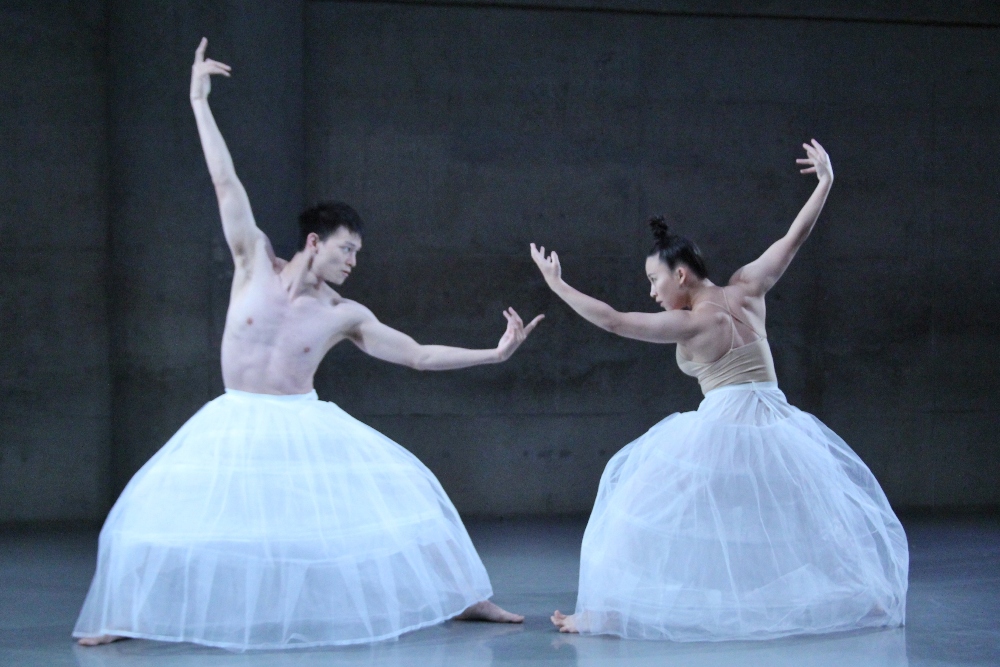
3. The scene in the middle section of our work, where everyone dances together for the first time. We also invited the B.DANCE dancers visiting from Taiwan to participate here.
4. The scene of closing the novel’s final page.
Having works exchange with one another in this way was a very interesting experiment. Within it, dancers encounter new selves, encounter new bodies, and dance new stories. In recent years, dance has also been involved in various collaborations: music, painting, video, and so on. The person on the right, the person on the left, the person next door, the neighboring country: from nearby to far away, and not limited to dance, I hope many kinds of exchanges will arise and many wonderful vistas will come into being.
It is a small thing, but this time I felt that it is also very important for dance sometimes to turn toward such a direction.
Mitsutake Kasai
Excerpt from Session House Annual Report 2018
Photographs from the performances on November 24 and 25, 2018
Dance Bridge International 2018, from Tokyo
Naoko Ito’s “Traveling Companions Theater”
Overall direction by Mitsutake Kasai: “Taiwan (Women and Men) × Japan (Men) × Japan (Women)”
Top photograph: Mademoiselle Cinema’s “Crossing the Sea”
Middle photograph: Mitsutake Kasai and Baraba Okuyama, “The Secret of the Rose”
Bottom photograph: B Dance company, “Floating Flowers”
