
Session House Annual Report 2018: Yo Nakamura
Overall direction by Yo Nakamura: “A Fascinating Dance Gathering—with a Guide!”
—The Anger Behind Hospitality—
A challenge arrived from Session House: “RETHINK HOW DANCE IS DELIVERED AND MAKE THIS A GROUNDBREAKING PERFORMANCE.” And so began our struggle with Dance Bridge’s “Fascinating Dance Gathering.” I mainly considered two things.
①Expand and contract the physical and emotional distance between the audience and the dance.
②Add commentary that lets the work be enjoyed more richly—like salt on watermelon—not by “just talking,” but in a way suited to the work.
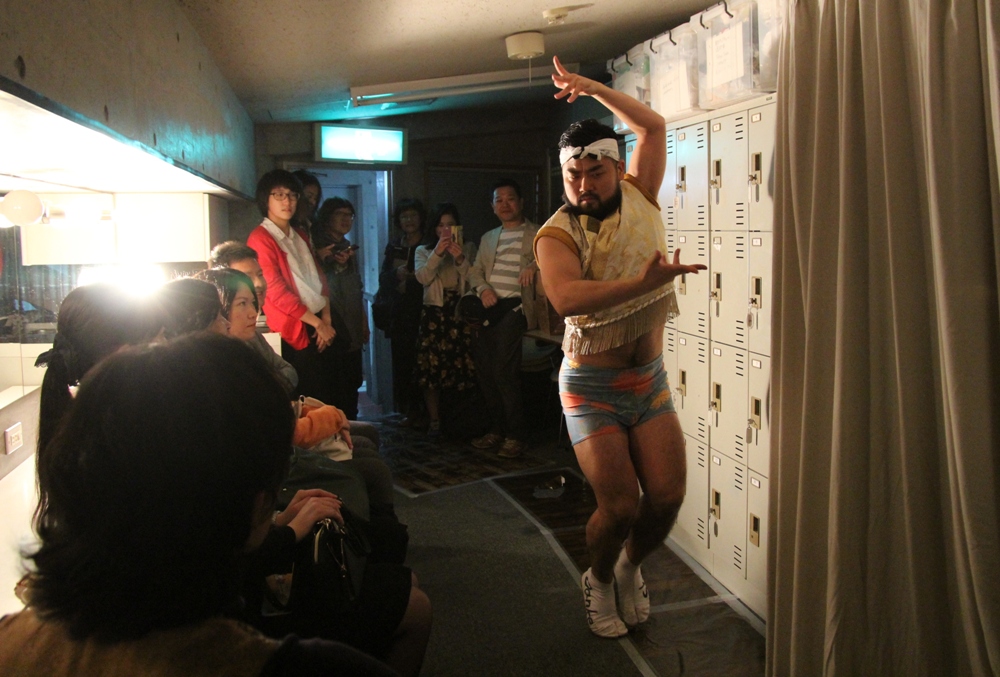
For ①, taking inspiration from art museums, we tried having dancers and musicians perform simultaneously in the dressing room, lighting control room, foyer, studio, and elsewhere during the thirty minutes while the audience entered. Although visitors followed a set route, they could watch as many times as they wanted within that period, and could basically leave each place whenever they wished. The aim was to awaken the viewer’s active agency: “You can choose your own distance from, and time with, the dance—expand and contract them.” And by letting them experience the theater’s backstage spaces, such as the dressing room and lighting control room, which they rarely see, I wanted them to savor the three main works that followed together with their spaces, as “works danced within this building.” That intention also led us to change the acting area for each of the three main works.
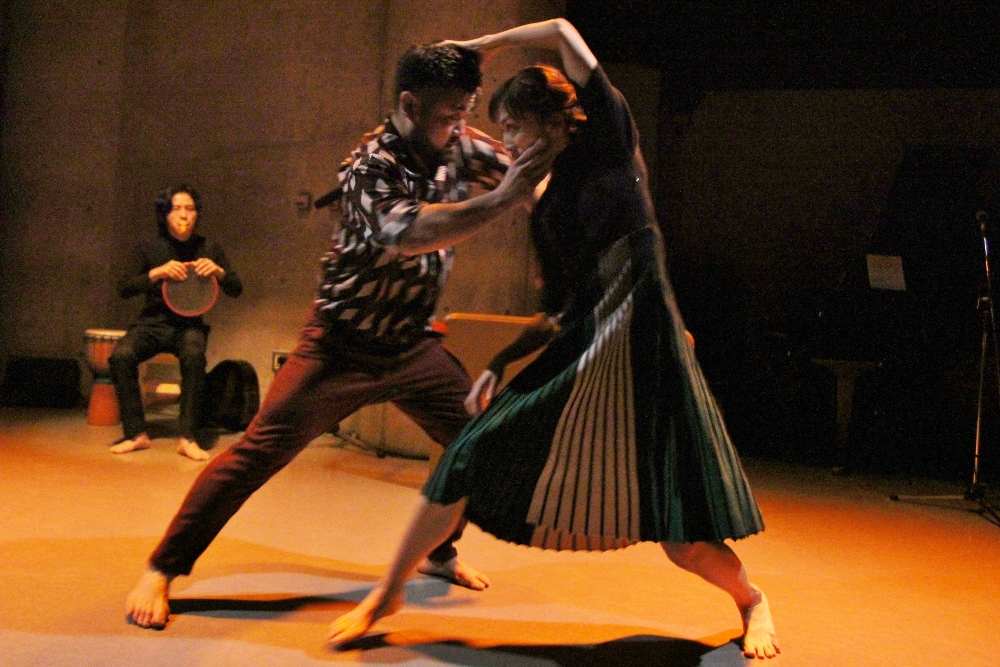
The forms that emerged from ② were simultaneous interpretation in Japanese and English, a rakugo preamble, and an explanation of “Ashura” fashioned like a parody of the opening of the original television drama. As I asked each creator about the circumstances and concepts behind their work and considered the most suitable commentary style with them, I too, as overall director, was able to develop an understanding and responsibility that went beyond “just lining up works.” The “commentary performances” had by then gone beyond mere extras and required more people. I feel that among the performers rushing about, a sense of unity naturally arose across the boundaries between works.
What made a strong impression in this production was its growth on the second day. On the first day there were things we had not fully anticipated, and many moments of confusion. In response, at the first-night gathering immediately after the performance, all the performers and staff quickly worked out countermeasures from questionnaires and audience comments, deciding on improvements for the next day: changing the viewing route, raising the stage, projecting video on two surfaces, and more. That time, when performers and staff united without compromising at all, not just on the works’ content but on “the best way to deliver a work,” was, I think, a groundbreaking moment filled with energy that made dance’s future shine brilliantly.
Looking back, the origin of this trial and error over “how to deliver dance” was, in my case, certainly not “a hospitable spirit toward the audience.” To say it honestly now, what I had was “anger.” At myself, for wanting to break through farther yet failing to stand out and instead wrapping things up deftly; at a world in which dance’s value never rises, at creators and seasoned theatergoers unable to raise that value, and at everyone involved in Japanese contemporary dance. I did everything I could to make every person who came away grasp the feeling that “I could not remain a bystander toward the dance before my eyes.” It is neither I alone nor you alone who make dance interesting; I wanted us to feel, together, that both you and I are needed. I think my anger, the magma I can only turn into comedy, appears strongly in the new work “Like Ashura,” presented in this production. As a result, audience reactions were very concrete and clear. Many questionnaire responses were frank—“I want you to do this,” “This was disappointing,” “This drew me in”—and they were extremely useful in improving the next day’s performance. In spoken responses too, I was saved by the audience’s flushed faces and their determination to communicate somehow, rather than trying to reduce their impressions to simple words. Personally, I am truly grateful that the entire cast and staff, beginning with core members Yuya Igarashi (五十嵐結也) and Maki Ito (伊藤麻希), rushed about and fought hard with the spirit, “If we’re doing this, let’s show the power of the younger generation to the fullest!” For me, accustomed for better or worse to taking all responsibility alone, this became an important production in which I felt surprise and deep emotion at having companions who would fight, cry, and laugh with me. At the same time, it gave me a resolve to “take responsibility for the future of the contemporary dance world.”
Yo Nakamura
Excerpt from Session House Annual Report 2018
Photographs from the performances on November 3 and 4, 2018
Dance Bridge International 2018, from Tokyo
Naoko Ito’s “Traveling Companions Theater”
Overall direction by Yo Nakamura: “A Fascinating Dance Gathering—with a Guide!”
Top photograph: performance throughout the venue; dancer: Yui Igarashi (五十嵐結)
Bottom photograph: “Like Ashura,” choreographed by Yo Nakamura; performers: Yuya Igarashi (五十嵐結也), Yo Nakamura; musicians: Takayuki Kanai (金井隆之), Saya Hasegawa (長谷川紗綾)
