
Session House Annual Report 2018: Chikako Kaido (皆藤千香子)
What It Means to Choreograph in Germany
I am writing this after finishing the performance of my new work in Düsseldorf yesterday.
I received my education as a dancer and choreographer in Germany.
I went to study in Germany because I felt that dance in Japan lacked a tradition, whether ballet or contemporary dance, and because I thought that if the meaning of being a choreographer was to put something forward to contemporary society and influence it, I should leave Japan and see the world.
But afterward, before I knew it, more than fifteen years of life in Germany had passed. I think that must mean that Germany offers me the fulfillment and goals I seek in choreography.
I entered Folkwang University of the Arts in 2002, and was able to enjoy the last seven years before Pina died. Even when it is the same work, what Pina’s company performs now is completely different from my memories of seeing it as a student.
I cannot forget the atmosphere of the works when Pina was still alive. The slightest glance or gesture from a dancer, the tiniest shift in timing, changes a work completely.
Seeing Pina watching the dress rehearsal from the audience, you could feel her controlling the flow of time. It also came across that the dancers were dancing for her rather than for themselves.
And at the end, when the audience applauded, she was always onstage. The experience of immersing myself in Pina’s works as a student forms the foundation of who I am as a choreographer. Creating works of that strength became my goal.
Another person who strongly influenced me was Susanne Linke. As a choreographer, she created a work for our university graduation performance.
I think she was entering her sixties, but she was still dancing with tremendous vigor. Her bathtub solo in particular was truly extraordinary, and I felt a shock like nothing since seeing Kazuo Ohno in Japan.
When you have an opportunity to see something so extraordinary, you cannot help asking yourself what you can do.
I was also strongly influenced by the choreographer of NEUER TANZ, who is of the same generation as Pina Bausch and Susanne Linke and works in Düsseldorf.
He is a photographer. Düsseldorf’s art scene is interesting and strongly influenced by Joseph Beuys. Dance works made by a photographer within that art scene resembled visual artworks, offering unbelievable forms of expression from a perspective entirely different from works by choreographers trained in dance.
I think I have stayed in Germany so long precisely because I feel the significance of making work in an environment with artists who serve as my goals. Europe is also more multiethnic than Japan, and you can create works with artists from all over the world.
A country’s history, culture, and spirituality dwell in the body, and you can sense that country’s current situation too. The ability to gain a broad perspective as a choreographer in that way is another attraction.
Appearing in Session House’s Quatre-Quarts performance, which prompted me to write this piece, became a milestone for me.
That is because long ago, after taking a ballet lesson at Session House, I was drawn by music that felt magical and peeked into Naoko Ito’s class from the stairs behind the changing room. Wondering what this mysterious, wonderful atmosphere was became the spark for my interest in contemporary dance. Thinking about what it meant to perform there as a choreographer twenty years later, and about Naoko and Takashi Ito being there just as before—and even more powerfully—filled my heart.
Whether in Germany or Japan, I think it is difficult to live as an artist, and we encounter many hardships. But when something like this happens, I can feel glad that I have persevered all this time!
And although until now it has taken all my energy to establish my own style, I also feel that experience accumulated over this same long period is becoming my strength. So I feel I must also consider “passing on” to the next generation what Pina and Susanne taught me.
Chikako Kaido (皆藤千香子)
Excerpt from Session House Annual Report 2018
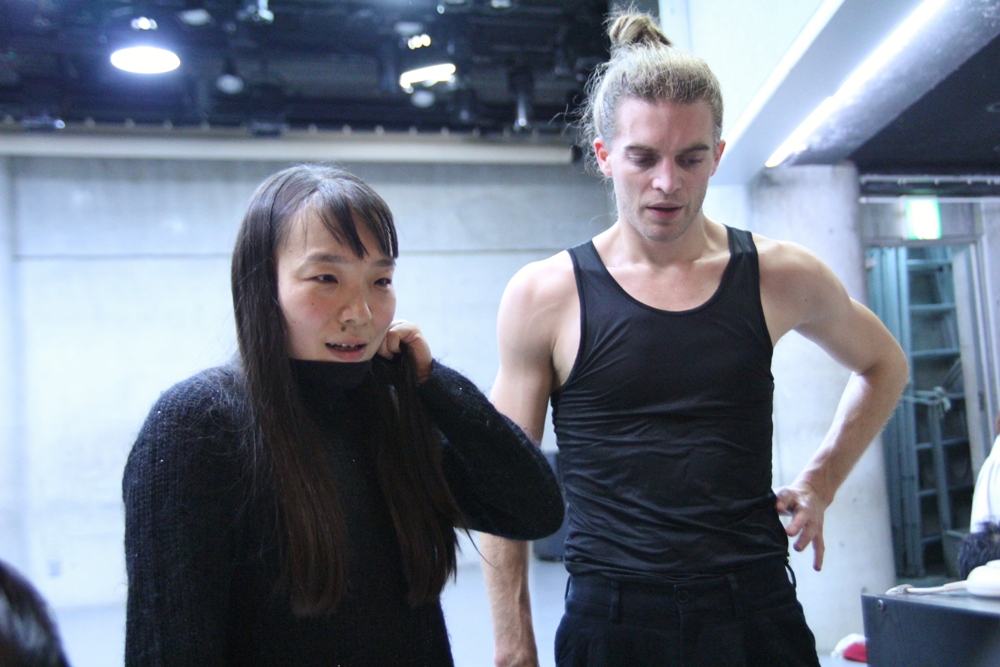
Photograph: Chikako Kaido (皆藤千香子) and Jascha Viehstaedt (ヤシャ・フィーシュテート) in a meeting with staff for the Quatre-Quarts performance
