
Session House Annual Report 2018: Baraba Okuyama
“The Art of the Interval (間術)”
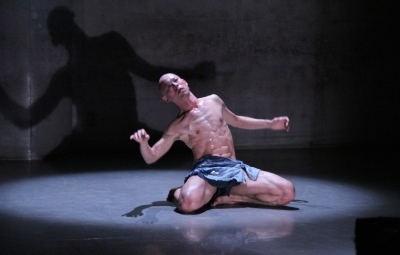
Baraba Okuyama
Having begun to find pleasure in dancing as a solo, as a single point, I presented an independent solo work at Session House last year, carrying with it a desire that has welled up in recent years: simply to dance, wholeheartedly. And through exchanges with various dancers and choreographers, my desire to explore new possibilities in this body of mine, which has until now practiced the bodily expression called butoh, has deepened. In doing so, I also feel that it may be necessary to look back at and examine the body I have had up to now.
A body that simply remains still while burning internally. An unrelenting mass. Flesh that adheres as though being compressed. I have consciously worked with this as one way of putting the body onstage. I think flesh emits a magnetic force. It is a force that powerfully gathers gazes, and at the same time makes people keep their distance from what they are looking at. Gazes seem to gather around a body condensed into a mass, the target of the conscious act of “seeing,” while remaining apart. “While remaining apart”: if you delve into books, examples are given of things one might want to gaze at from a truly unapproachable distance—the walk of a condemned prisoner toward the execution ground, or the ribs protruding from a dog being beaten. I have a real sense that even today, a body condensed into a mass comes alive through being observed intently from a distance. For flesh to become a magnet without reservation and condense, it needs the breadth and distance in which to release a magnetic field.
I enjoy going to see all kinds of performances, regardless of genre. Sometimes I go to see works by dancers I respect hoping to be utterly knocked flat. And when I discover an actor standing onstage emitting a strong magnetic force, I sometimes find myself shouting inwardly, “This is butoh!” I want to cultivate that perspective too: finding butoh outside butoh. And when I see a moving work that shakes my heart, or a performance that gives me overwhelming excitement, something often spoken of happens: my sense of time feels strange.
Through both positions—seeing from the audience, and standing onstage and being seen instead—I sense that gazes flow into the stage while transforming in thickness, growing thicker or thinner with the various changes in the viewer’s perceptions and mental images: surprise, emotion, joy, sadness. As the thickness of those perceiving gazes, gathered perhaps at a dancer’s fingertips, extends and contracts, one second on a single tick of the scale in that place ceases to be just one second. It becomes heavier or lighter, deeper or shallower. I feel that such things are continually happening.
With a single movement, a dancer can swell or shrink the thickness of the gazes gathered around the body.
Perhaps dancers are a kind of people who can manipulate time.
Magicians—or rather, practitioners of the art of the interval.
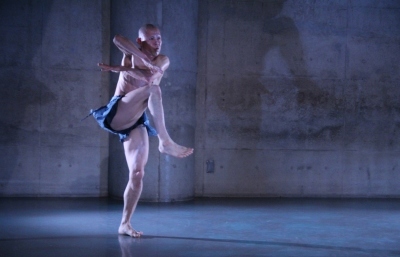
If I put my current thinking about dance into a single phrase, these are the words I arrived at. I intend to enjoy seeing how those words change from here on.
Baraba Okuyama
Excerpt from Session House Annual Report 2018
Photographs from the performances on June 23 and 24, 2018
Baraba Okuyama’s solo performance “Sasoharete (サソハレテ)”
