
Voice of Ichie Watanabe
The writer Ichie Watanabe began holding her talk series “Let's Listen to the Voices of Fukushima” a year after the great earthquake that struck eastern Japan on March 11, 2011, and the Fukushima nuclear accident. Three meetings were held last year, but the threat of radioactive contamination continues, as the areas still designated difficult to return to demonstrate. Please listen to the voice of Ichie Watanabe, who organises these gatherings.
“Fourteen Years After the Nuclear Accident: Fukushima Today” — Ichie Watanabe
Fourteen years have passed since the explosion accident at Tokyo Electric Power Company's Fukushima Daiichi Nuclear Power Station in March 2011. At first, in the name of conserving electricity, shops and businesses turned off their neon signs and shortened their hours, and Tokyo's nights were dark and quiet. But that lasted only a very short time. Even so, voices opposing nuclear power and calling for an end to it filled the streets, and rallies were held in many places.
It was amid that movement, on March 7, 2012, that we held the first “Ichie Watanabe Talk: Let's Listen to the Voices of Fukushima!” at Session House 2F Garden. Having begun travelling to Fukushima in August 2011, I wanted to convey the situation there by holding meetings where we could hear directly from those affected. I consulted Takashi Ito (伊藤孝) of the Session House Planning Office, and he made it possible. The meetings have continued ever since, and on February 22 this year we will reach the 48th. In the beginning, nearly 100 people attended each meeting, but recently the number has been around 30.
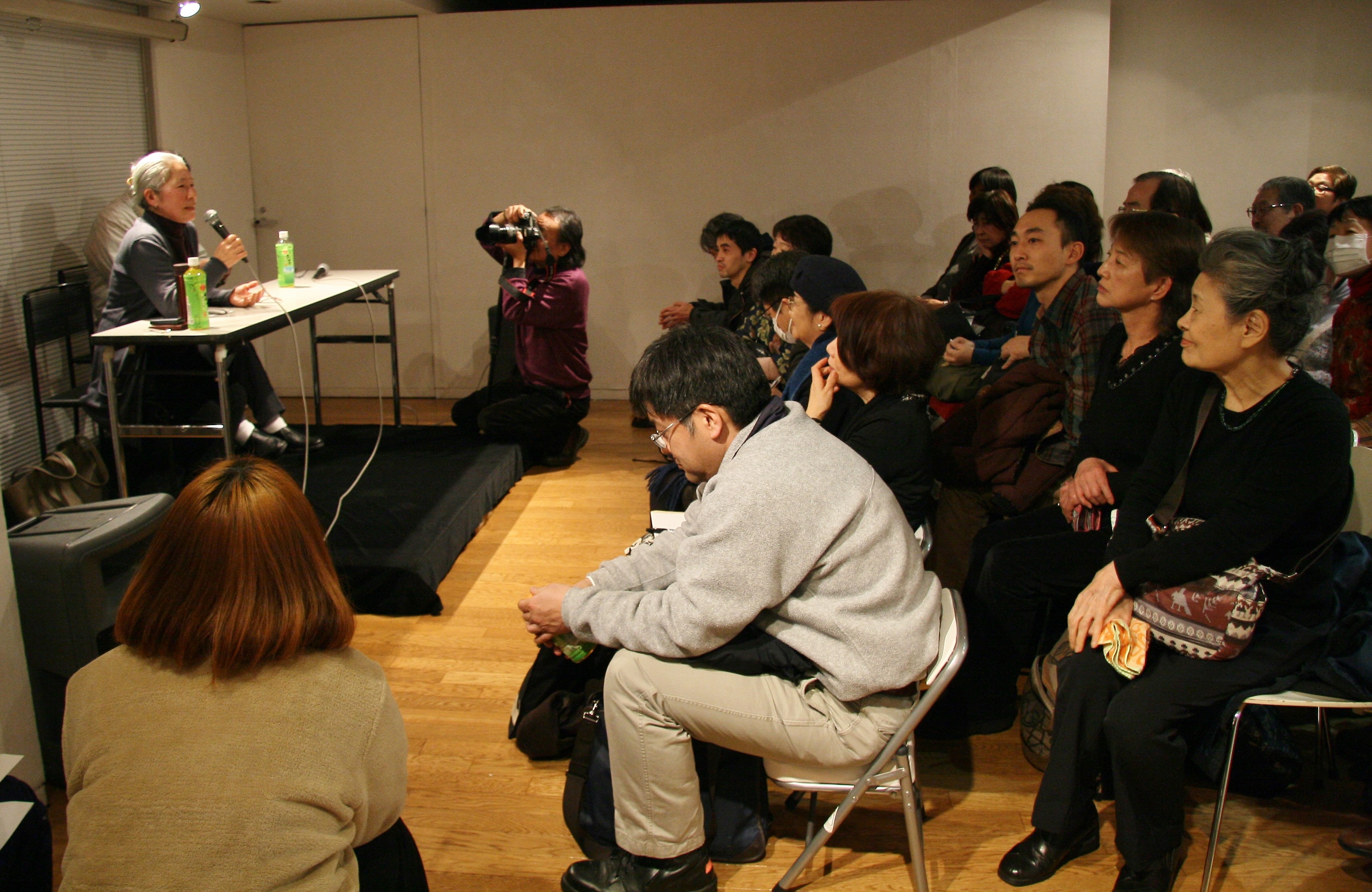
Much of what newspapers, television and other media report about Fukushima since then describes places that have “recovered.” They do not report that tens of thousands of evacuees remain, or that Fukushima Prefecture (as well as Tokyo and Osaka City) is taking evacuees to court in “eviction lawsuits.”
Nuclear power plants were built as national policy with assurances that they were “safe and secure.” Now that an accident has happened, it seems as though the aim is to make people forget it quickly, to pretend it never happened.
It is true that, if you visit, the Joban Line station buildings at Futaba, Ono, Yonomori and Tomioka have all been rebuilt, and large vehicles move back and forth around them in areas earmarked for redevelopment. Major redevelopment will also take place around Namie Station. Apparently it will be a town development designed by Kengo Kuma, integrating the station building with the area in front of it.
Evacuation orders have been lifted in the municipalities of Fukushima's Hamadori region that were subject to them after the nuclear accident, except for the difficult-to-return zones. Yet contamination remains, and conditions have not returned to a state in which people can live with peace of mind. Residents who gave up on returning applied, with their hearts torn, to have their ancestral homes demolished. In these areas, where vacant lots have increased and populations have fallen sharply from pre-accident levels, measures to attract new residents are being promoted through events called “relocation seminars” and the like. One place proclaimed itself a “reconstruction frontier,” but that phrase brought to my mind the history of the opening of the American West. Relocation measures include housing purchase subsidies of two to five million yen, and subsidies for expenses of up to four million yen as support for starting a business. Media coverage of post-accident Fukushima makes a great spectacle of the companies and organisations established in this way.
For younger generations to move there, support for child-rearing is also necessary. Rebuilding schools was tackled early, with certified centres combining nursery and kindergarten built together with integrated elementary and junior high schools. At these newly established schools, for example, uniforms by famous designers are lent free of charge, and school songs are written by famous poets. Preferential measures include parents not having to contribute to school-trip funds and free school supplies. As a result, there are quite a few cases of residents who still live where they evacuated, while keeping their residence registration at their original address, sending their children to the newly established schools. In such cases, school buses provide transport from the places to which they evacuated. The government's stance of encouraging relocation while providing no information about radiation exposure calls to my mind the history of settling Manchuria.
Another widely publicised development was the opening of “The Great East Japan Earthquake and Nuclear Disaster Memorial Museum” in Futaba in September 2020. Rather than conveying and passing on the realities of the disaster, this is a facility explaining and promoting the “Fukushima Innovation Coast Framework,” a reconstruction project encompassing decommissioning, robots and drones, energy, environment and recycling, agriculture, forestry and fisheries, medical fields, and aerospace. Seen as its command centre is the “Fukushima Institute for Research, Education and Innovation (F-REI),” to be built in Namie. This facility has signed a memorandum of understanding with the United States' “Pacific Northwest National Laboratory (PNNL)” and will work in partnership with it.
PNNL is in Richland, near the Hanford nuclear facilities that produced the plutonium for the atomic bomb dropped on Nagasaki, and develops measures focused on national security. In other words, it is a military research facility, and alongside that it is also a facility that “strengthens the US nuclear industry so that it can compete globally.” In other words, everything promoted by the Fukushima Innovation Coast Framework is a national project that can be diverted to military use, and it is also a framework for promoting nuclear power.
Speaking of this national reconstruction plan, H, a local resident who evacuated from Namie to Nihonmatsu, says: “The town we originally imagined was one in which culture would grow and life would continue within the warm connections among the townspeople who had lived there. I cannot help feeling that, through the large projects the government is promoting, our town is becoming an area whose scenery and people's hearts bear no resemblance to what they were before.” This is not just H's feeling; it is shared by the great majority of local residents.
Travel companies offer tours to Fukushima under names such as “Hope Tourism,” but their itineraries include newly built schools and town halls, and commercial facilities established by new businesses, all intended to impress upon visitors “Fukushima's recovery.” If you want to see the reality of Fukushima, I would like you to join the “disaster-affected area tours” I organise, rather than these tours that accommodate the government's wishes.
Not just Fukushima but the whole Tohoku region has contributed to this country's economic prosperity by supplying food, labour, energy and much else. Yet the saying “North of Shirakawa, a whole mountain is worth only three mon” is still not obsolete. I cannot help seeing this as a “colonial mentality.”
Ichie Watanabe
Excerpt from Voice of Session House 2024
