
Voice of Satoshi Ishibuchi
Satoshi Ishibuchi, who formed part of the musical ensemble for “Dance Bridge: Tokyo no Okuni,” the final production of 2024, contributed an essay analysing the achievements and significance of its collaboration with dance.
Dance and Music Working Together in “Tokyo no Okuni”Professor, Daito Bunka University — Satoshi Ishibuchi
From its creation stage, “Tokyo no Okuni,” performed in December (choreography and direction: Naoko Ito), radiated an inscrutable energy, rather like a local festival somewhere in Japan. Its cast of nine centred on Mademoiselle Cinema's familiar regular members, joined by two men, Mitsutake Kasai and Takahiro Mochizuki, and young female dancers in their twenties. The musical ensemble consisted of two people: the professional chindon street-music artist Monaco Kurihara (栗原モナコ) and myself, Ishibuchi.


What I want to describe here is how extraordinarily enjoyable and rich it was to watch scenes come together in rehearsal as the music was composed alongside the choreography. I want to put into words the feeling that “dance and music share their roots to an astonishing degree” that came from everything being born “here and now” in the dance rehearsal room. This differed from, for example, a method in which a musician watches a scene, returns a few days later with suitable music, and then puts the scene together through further rehearsal. (It is probably true that this latter method can produce more tightly crafted music, since more time has been spent composing it.)
In the first place, local festival music groups—where even now children are taught drums, flutes and dance as a community activity and perform them as offerings at New Year or festivals—often make no sharp distinction between those who dance and those who play. Just the other day, a member of a local festival ensemble told me that children first learn dance alongside the drum; once they can drum and grow a little older, they begin the shinobue flute. The adults teaching them all take turns drumming, dancing and playing flute on stage. In other words, in this case dance and music are not divided into separate jobs.
Whether it was the subject of “Okuni” that called this forth, or the guidance of choreographer and director Naoko Ito, the truth remains in the shadows, but the successive miracles of sound and dance being born together took place with astonishing naturalness. Monaco and I already knew each other, so teaming up was no problem at all. But we had no information about how many scenes we would play in or which instruments we would use. With a casual “It seems to be a Japanese-themed subject, so shall we bring along instruments that might work?” we gathered our instruments and began playing with sounds. Of those instruments, Monaco played alto saxophone, shamisen, chindon drum, small percussion, accordion, voice and saz (Turkish guitar); I played shinobue, shamisen, mandolin, sasara, accordion, erhu, voice and so on. As work progressed, I learned that Ito had deliberately brought together two people who could each play several instruments, apparently wanting us to change the sounds we made from scene to scene.
For example, while a duet scene for Tamami Takenoshita (竹之下たまみ) and Mitsutake Kasai was being created, the moment we introduced the sounds of accordion and alto saxophone, the scene sprang to life. Of course, we were not dancing, nor were the dancers playing instruments. Rather, the dancers made the music sound, and the musicians made the two dancers dance. There was not the slightest trace of the cold, dry, workmanlike procedure implied by a division of labour; an “explosion of encounter” appeared.
Looking back, I can identify several conditions that allowed us to welcome such miracles. One major factor was that all of Ito's choreography and direction took place in “silence.” It is common for choreographers and dancers working on a scene with a “temporary stand-in track” to let “the image of that music” lead the way. Ito knew this very well, and for the scenes with live music she used no pre-existing tracks at all, creating them “quietly and steadily in silence” (though I think “in a state of tremendous excitement” is closer than “quietly and steadily”). Another factor was that, when the ensemble added music on the spot to scenes made in silence, we chose instruments based on our impressions of the cast and the atmosphere of the preceding and following scenes. Then, at the signal “Let's begin!” we offered the performers music through “improvised playing,” watching the dancers' movements as we played.
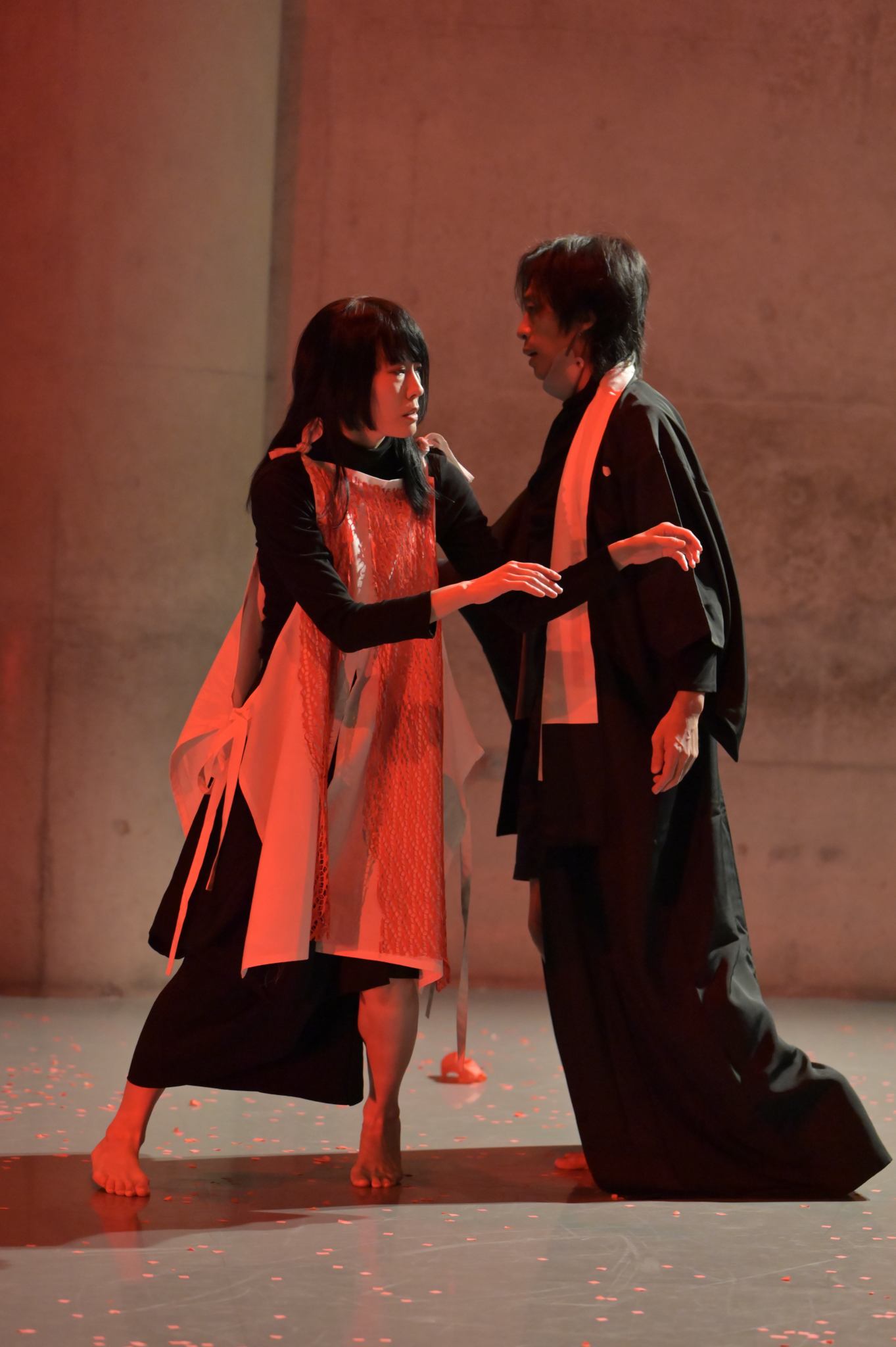
Sometimes we “rose or subsided” in sympathy with the movement; at other times, to “bring the movement into relief,” the music remained resolutely “still.” Or all such calculation would fall away and we would play “simply swept up in it.” After several runs together, what had been improvised “naturally acquired a form” and truly fell into place. It is not difficult to imagine that a similar transformation was probably taking place for the dancers.
What Ito intended with this work was probably to trace the spiritual core of the life of the individual Okuni (or perhaps a collective individual), and thus bring onto the stage the human part of us performers: not dancers as dancing dolls, but nine individual “dancers clothed in flesh,” utterly entangled in love, honour, desire and the rest. And—well, blow me down, Tamegoro!—it did not stop there. In this work she (Ito) removed the boundaries of divided labour between dance and music, summoning a space in which dance and music have not yet become separate forms, the essence that the art of dance has inherently possessed since ancient times.
Satoshi Ishibuchi
Excerpt from Voice of Session House 2024
